

 Suchir Salhan
Exeter University has introduced a new film module that scrutinises the characterisation of characters like Eeyore as stubborn or comedic, or melancholic or intelligent, in film.
“This is problematic,” said Dr Benedict Morrison, senior lecturer and co-lead of the module in Exeter’s department of communications, drama and film, which also explores how donkeys have been portrayed in fables and fairytales, religious narratives, and documentaries. “What we lose is the donkeyness of the donkeys, and indeed the specific personality of the individual donkey.”
In an attempt to redress this, students will create video essays based on their interactions with and observations of the animals at the Donkey Sanctuary in Sidmouth, Devon, which has partnered with the university to run the course.The students’ visits to the donkey sanctuary brought them “literally face-to-face with the reality of donkeys as individual, thinking, living, sentient beings”, co-lead Dr Fiona Handyside said.
Queer Men in H Staircase and Relic Chocolate Wrappers Found in the Cambridge University Library
Workmen dismantling shelves at Cambridge University Library stumbled upon a sweet surprise when out fluttered an old orange chocolate bar wrapper of a the Crunchie bar manufactured at the time by confectioner Fry’s, with a pre-decimalisation (which took place in 1971) price of 6d emblazoned on it. The story attracted attention on social media with the University posting “OK, it’s time to ‘fess up. Who ate a Fry’s Crunchie bar in the UL and hid the wrapper behind some books?” The orange packaging and the price of sixpence indicates that it was produced before 1971, when decimalisation was introduced.
In other news, Simon Goldhill – a Classics’ Professor at King’s College– latest book, Queer Cambridge which explores the history of queer alumni such as E.M Forster who occupied one H staircase in King’s College. ‘People often feel very attached to these staircases, because of the intimacy of living so closely together with a few friends (or enemies),’ writes Goldhill in the introduction to his book. ‘In the imagination – and in reality – the staircase becomes a place where emotional memories are laid down, life choices made, friendships for life formed.’ Notable King’s Alumni include Alan Turing, who was convicted of gross incendency with his relationship with a man in 1952 but received a royal pardon for his conviction in 2013. Turing is memorialised by a 12.1ft statue between the Gibbs Building at the centre of Goldhill’s book and Webb’s court. The sculptor, Sir Antony Gormley, said that it was not “memorialisation of a death, but about a celebration of the opportunities that a life allowed”.
Goldhill’s book contains descriptions of the economist John Maynard Keynes, who kept ledgers of his list of lovers and ‘a dispassionate account’ of his sexual encounters. “He treats his pickups like he does his shares, you know. He tries to make maximum profit,” comments Goldhill. Virginia Woolf described Keynes as ‘a gorged seal… brutal, unimaginative’.
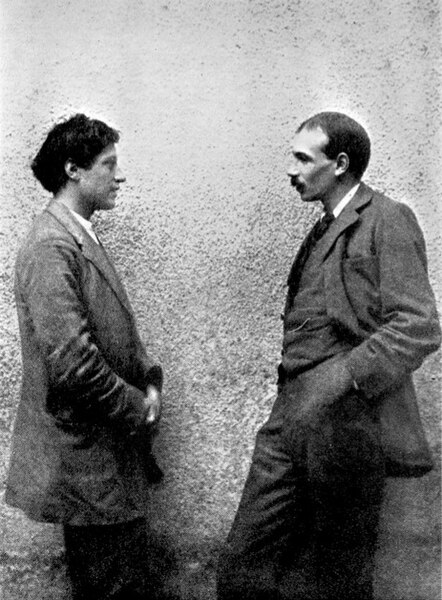
Economist, John Maynard Keynes (right), with painter Duncan Grant (left) at the home of Virginia and Leonard Woolf (Asheham House, Sussex). Keynes and Grant were in a relationship bewteen 1907-1914. Photograph from Wikimedia Commons.

Discover more from Per Capita Media
Subscribe to get the latest posts sent to your email.

